

Welcome back to The SQ1 Pivot! This week, we’re looking at what happens when our pipelines break down completely, and how a single headline may distract us from the much larger, systemic crisis lowering outcomes for Black New Yorkers and driving Black residents out of the city.
Let’s dive in.
Jared Giles
Founder, SquareOne
[email protected]
Where Should We Begin?
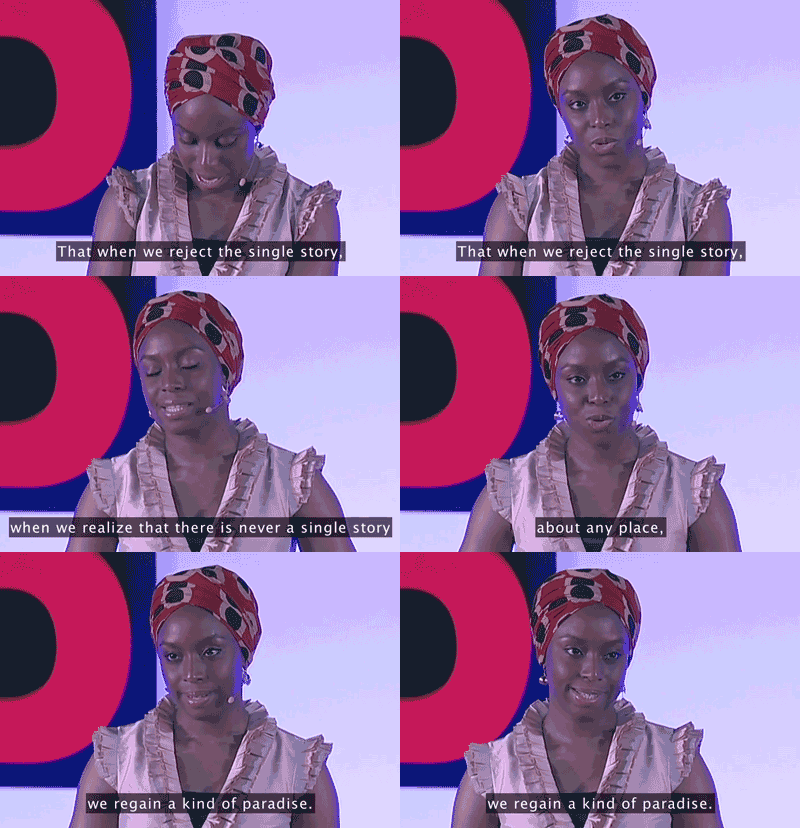
When I read that only 3 of the 777 offers for admission to Stuyvesant High School went to Black students, I was reminded of Chimamanda Ngozi Adichie’s TED Talk "The Danger of a Single Story". The news reignited calls for changes to the specialized high school admissions system, a relic from 1971. And while there should be outrage, I worry that focusing on that single metric clouds our ability to recognize the broader system that produced this result in the first place.
The statistic doesn’t live in a vacuum. In a recent interview, Mayor Zohran Mamdani highlighted that over the last 20 years, the city has lost more than 200,000 Black New Yorkers. And the Making Growth Matter report from ABNY and NYCETC noted that, from 2015 to 2025, unemployment among Black New Yorkers increased from 8% to 8.5%. Black New Yorkers were the only racial group to see a rise in unemployment during this time.
The outcome at Stuyvesant High School isn't an isolated incident. It is a symptom of a larger, systemic environment that continues to fail Black New Yorkers and, ultimately, drive us out of the city.
Looking at these statistics together, we can’t rely on the single story. Chimamanda quotes Palestinian poet Mourid Barghouti: “If you want to dispossess a people, the simplest way to do it is to tell their story and to start with ‘secondly’.” If we start the story of Black New Yorkers with Stuyvesant High School, unemployment, or outmigration, we risk missing the root that connects each of these issues. And if we can’t excavate the root, we have no hope of turning our system around.
Is our goal for more Black students to get into specialized high schools, or to ensure every young Black New Yorker has a quality education that affords them a life in the city? There is no neat solution to any of this, but my hope is that, from now on, we address these issues in full context of one another and invest in the policies, programs, and infrastructure that tackle root causes rather than patching symptoms.
So, what are we going to do about it?

National Spotlight: Dallas’s Early College High School Pipeline
How might we do things differently? Dallas is embedding higher education and high-wage career pathways directly into the core high school experience.
The Problem: Traditional high school pathways wait until 11th or 12th grade to introduce college-level coursework or technical training, by which point many underrepresented students have already disengaged from the academic pipeline.
The Intervention: Dallas Independent School District launched an expansive Early College High School (ECHS) and P-TECH model across 26 schools. Starting in 9th grade, students complete up to 60 tuition-free college credits, earn an Associate Degree alongside their high school diploma, and gain technical skills and mentorship through partnerships with local employers.
The Takeaway: Higher education and career pathways are a feature of the district, not an exception. Dallas has created a structural runway that bypasses standard admissions processes, does not rely on specialized high schools for student success, and prepares young people for high-wage local careers while greatly reducing, if not eliminating, debt.
P-TECH and Early College High School models offer a solution to multiple cracks in the pipeline. But comprehensive change will require us to look past the isolated headlines, understand the full context, and rebuild the entire system shaping how we live, learn, and work.
ICYMI
[READ] Op-ed: Dr. Meisha Porter asks how we choose to define and recognize excellence in light of the results at Stuyvesant.
[WATCH] TEDTalk: “The Danger of a Single Story” by Chimamanda Ngozi Adichie.
[LISTEN] The City Was Black: A six-part series from the AP that explores what it means to be a Black New Yorker in 2026.